Blog Requirements
Your blog should include:
- A daily reflection tied to one or more of the essential questions or enduring understandings. That reflection can be linked to something that we learned in class or something that you learned while doing your research.
- At least one song that relates to a social issue.
Your blog may include:
- Documentation of a day’s activities or details of a specific event
- Analysis of advice or conversations with your teacher
- Connections between any reading you are doing or came across and how it relates to your class and or research
- Questions you have
- Things you have learned about your research topic
- Things you have learned about yourself
- Evaluation of what you anticipated and the reality you find
- Photographs
- Video clips you have made or watched that are relevant to the class or your research
- Links to resources you have used to learn more about your topic
An effective blog records experiences, analyzes lessons learned, raises questions to pursue, and communicates the journey with an audience. As the weeks progress, the blog will reveal to the writer and the audience the full scope of what the student is learning and experiencing in the class. Since effective blogs demonstrate growth and discovery, writing in the blog consistently from the beginning to the end of is crucial.
BLOG POST #1: What is Latin America? (5/14)
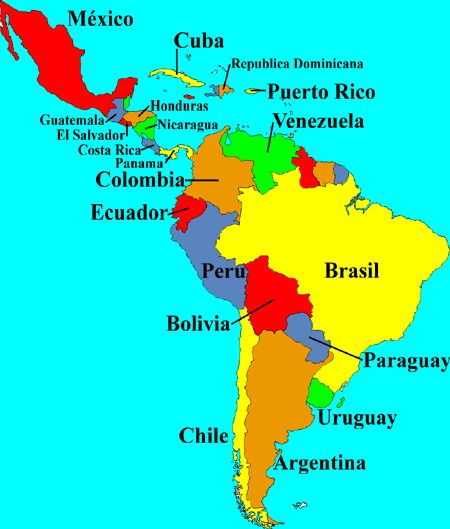
In today’s class, I learned about Latin America and the various social issues that affect countries in the region. Prior to this class period, I didn’t know much about the geographical aspect of Latin America, as I was unsure of the countries included in Latin America After having a concrete definition of Latin America in my mind, I am confident enough to participate in conversations about the history and social issues that have formulated within these territories and countries that encompass this region. I was able to use my new knowledge almost immediately as we spent the rest of the class researching and developing an in-depth understanding of one particular social issue in Latin America. By addressing the prevalence of specific current social issues in Latin America we are able to understand how they can relate to the rest of the world and educate ourselves on its culture and history. Furthermore, the class found that there were common broader themes of issues from many of the specific issues that were researched.
As a class, we created a chart demonstrating five big themes on the issues of Latin America. We agreed that human rights violations, economy, immigration, environment, and government were all prominent issues. Despite how different these issues are, this chart, interestingly enough, allowed the class to visualize the interconnectedness of all the issues researched. For example, issues related to the government can cause corruption which can lead to a bad economy and higher unemployment rates which could result in violence or even poverty which could all lead to immigration. To realize the way these issues connect it is interesting to reflect on this and think about how these issues contribute to the growth of other countries and downfall for others. Given the close relationship between all of these social issues, I would like to explore the order in which they are addressed: is there any issue that is more important than another?
Blog Post #2: Immigration (5/16)
Today, we talked about some differing opinions on immigration. One of the many subjects we had touched upon were statements such as this: “Banning immigrants and refugees from majority-Muslim countries will protect our country from terrorists,” and also how immigrants are supposedly taking good jobs from its citizens. Having pondered on these statements, I was able to reflect on my perspective of immigration and how minorities have been ultimately viewed in a bad way to U.S. citizens. What was interesting to me was that every statement that we read in class were simply opinions or assumptions made by people and we could either disprove or go against that opinion, but I do not that think that a single individual could make that opinion fact. As a society, I think that we easily judge what is unfamiliar to us, and for that reason, are keen to quickly believe information that we are not knowledgeable about. In this way, it is easy for people to create these stigmas against those who really have no intent to danger us, thus creating tension and hate for the unthreatening. I think that it is human nature to regard something that is unfamiliar as a possible threat or discomfort to one’s way of living. In this case, the negative attitudes towards immigration are most likely people being more concerned with their own well being, rather than understanding the reasons why people are seeking solace in a different country.
I also realized that a single individual could take action and make a small difference in people’s lives. For example, you could join small non-profit organizations in helping migrates or other people that are seeking refuge. Through volunteer work, it is possible to not only help minority groups, but also bridge gaps between them and other members of society. Humanity is a value which exists across all groups in society, minority or not, a concept which volunteering has the power to emphasize.
Blog Post #4: Taking Risks (5/17)
Today, we learned about the implications and consequences that immigrants face, specifically children, in their attempts to flee their homes. After watching the documentary called “Which Way Home,” I was surprised to learn about the reasons on what causes children to make these decisions for themselves to leave for the United States alone. For Kevin, a 14 year old Honduran, the purpose of setting out on such a difficult journey was to better the impoverished lifestyle which he and his mother lived in Honduras. Starting a new life for himself and his mother in the United States would also distance his step-father who treated them poorly. Some children that accompanied him have lived and survived alone for most of their lives (children were either 13 or 14). I found this information shocking because I couldn’t imagine because I couldn’t imagine living on my own or even trying to find direction in my life at such a young age. While it is sad to learn about the many children that face these obstacles everyday when taking path to the United States, I was more inspired by their willingness to keep going, and their willpower to fight for themselves and their families. In addition, the documentary also made me think about all the other possible reasons for leaving their homes besides poverty. A lot of them had family already in United States and wanted to get across the border to find them. However, this is difficult for many children because they are not given the information necessary to locate their parents once they arrive. I wonder why parents don’t leave an address or phone number for their children once they leave for the United States? Besides using smugglers to help their kids cross the border, what other actions can parents take to reduce the risk of their child being abused or harmed? How do parents choose the people that help their children get into the United States?
Blog Post #5: Environmental Issues (5/22)
Latin America faces numerous environmental issues, a few of which are oil production, pollution, deforestation, and illegal mining. Deforestation, in particular, is a huge concern in Brazil and Peru. With deforestation comes additional environmental problems, such as environmental problems such as erosion, aridity and a decrease of biodiversity is caused by habitat damage. Cutting down numerous trees and other vegetation can cause climate change, soil erosion, flooding, increased greenhouse gases in the atmosphere and other problems for indigenous people (fewer crops). Pollution, on the other hand, deals with the presence of the world’s unnatural elements, such as big factories and cars. The water and air pollution which such machinery produces is another particular concern for Latin America as those who live in urban areas are likely to live close to contaminated waters. Is the lack of recycling one of the major reasons for air pollution? The huge oil rig production crisis in Venezuela also prompts a lot of environmental issues as far as the polluting of water and drilling holes in the ocean that releases gasses. Illegal mining is also a cause of concern, as 90% of the gold that is found in Venezuela is due to illegal mining. Mining has a negative impact on the environment, similar to deforestation, it causes erosion, as well as sinkholes, and soil contamination. While caring for the environment is more than necessary, many details about the aforementioned environmental issues remain unacknowledged by the public. Given the unintentional blindness that has hindered progress addressing these environmental concerns, awareness plays a crucial role in future progress. Caring doesn’t have to go to extremes, such as, getting rid of your car, or refusing to buy jewelry because you suspect it’s constructed with materials found through illegal mining. It’s all about being aware of the issues and educating others about what’s happening, the discussion will continue and sometimes that’s all that matters. If people start to care more than upcoming generations will most likely continue to care. I think that when it comes to environmental issues communities should pay special attention to future consequences. I think one of the larger problems at play is that people are not fully aware of the consequences of their actions and they don’t think that it can influence certain situations in the future. However, addressing and coming up with solutions on how to fight these problems will alleviate some of the challenges that could be faced in the future.
Blog Post #6: Dictatorships (5/28)
The Universal Declaration of Human Rights protects the individual rights of people in nations that have chosen to adopt the document. This doctrine consists of several rights that connect to some of the topics that we discussed about Argentina in class. For example, there were over 360 detention centers locations in Argentina. Due to Argentina being under a dictatorship, leaders used these detention centers sa way to instill immense fear in citizens that may or may not have attempted to go against the government. People, including children, were kidnapped and later labeled as one of the “disappeared.” Disobedient behavior, such as, resisting the regime, or expressing disagreement with its principles—often guided the government in its decision about which citizens should disappear. Inside these detention centers, prisoners faced routines consisting of brutal interrogations and torture. Governmental officers that surrounded these detention centers also brutalized the prisoners causing them to lose their ability to sleep walk, or eat. What is interesting is what doctrines were put in place that essentially keep people protected of their rights. However, a lot of these rights were immediately stripped from people because they are living in an authoritarian regime. Due to this dictatorship, Argentinians were essentially owned by the government. If any Argentinian were to say anything that did not necessarily align with that of the government’s principles then the government would take extreme measures to punish you by either torturing you or your family. Some of the most basic rights I immediately thought of were an individual’s rights to freely express their opinions (19) and to be free of torture (5). These rights do not exist for those that live in this society due to the corruption of governmental leaders and certain government regulations that were put in place. In comparison to the “Facts and Figures” information handout I was able to connect this back to the statement that was made on the second page “to protect the most vulnerable, explicit protections now exist in international law to cover, among others, children, women victims of torture and persons with disabilities” are put in place but why do we still do it.
Blog Post #7: Environmental Issues (5/29)
The Universal Declaration of Human Rights protects the individual rights of people in nations that have chosen to adopt the document. This doctrine consists of several rights that connect to some of the topics that we discussed about Argentina in class. For example, there were over 360 detention centers locations in Argentina. Due to Argentina being under a dictatorship, leaders used these detention centers sa way to instill immense fear in citizens that may or may not have attempted to go against the government. People, including children, were kidnapped and later labeled as one of the “disappeared.” Disobedient behavior, such as, resisting the regime, or expressing disagreement with its principles—often guided the government in its decision about which citizens should disappear. Inside these detention centers, prisoners faced routines consisting of brutal interrogations and torture. Governmental officers that surrounded these detention centers also brutalized the prisoners causing them to lose their ability to sleep walk, or eat.
What is interesting is what doctrines were put in place that essentially keep people protected of their rights. However, a lot of these rights were immediately stripped from people because they are living in an authoritarian regime. Due to this dictatorship, Argentinians were essentially owned by the government. If any Argentinian were to say anything that did not necessarily align with that of the government’s principles then the government would take extreme measures to punish you by either torturing you or your family. Some of the most basic rights I immediately thought of were an individual’s rights to freely express their opinions (19) and to be free of torture (5). These rights do not exist for those that live in this society due to the corruption of governmental leaders and certain government regulations that were put in place. In comparison to the “Facts and Figures” information handout I was able to connect this back to the statement that was made on the second page “to protect the most vulnerable, explicit protections now exist in international law to cover, among others, children, women victims of torture and persons with disabilities” are put in place but why do countries still purposely torture and even murder innocent people and their families?
How can be address these situations when we can’t necessarily help these people that are suffering? Although, we can assist these people when they are caught, being aware about where governments fall apart when they address their citizens’ rights can definitely prevent us from allowing our rights to be taken away from us.
Blog Post #8: Comparing Movie and Articles (5/29)
After watching the movies “No” and “Imagining Argentina” and reading the articles, I found all sources to contain the similar message that there is a correlation between violence and a country’s lacking respect for human rights. There is a correlation between the the increase in violence and the violation of certain human rights. I read the article about violent crimes enduring in the country of Honduras. In the movie “Imagining Argentina,” a young woman who was a journalist found it necessary that her thoughts about the government should be shared with the public. Even though doing so would mean simply exercising her human right to free speech, the rules outlined by a the country’s dictatorship did not tolerate her actions. The women was kidnapped and sent to one of the many detention centers in Argentina where she was brutally tortured and raped. Subsequently after she was taken, her family was targeted because of her refusal to give out information to the officers. In this way, we can see many of the rights being violated similarly to how violence has uprooted its way into communities of Honduras. The article explained the increase in violence in many communities because of a violation of human rights. For example, “twenty-five journalists were murdered between 2014 and 2016 according to the human rights ombudsman, CONADEH, which also revealed in its 2016 report that 91 percent of killings of journalists since 2001 remain unpunished.” Similarly, journalists are targeted because it is very easy for them to share their government opposition to the public, but it is also very easy for them to convince the publics of this too. Despite the government not allowing this, they want to stay in power so they terrorize and make people suffer for not being loyal to the government.
The political situation in Honduras is limiting journalists in their ability to express their thoughts and opinions, which serves as the very foundation of the profession. When under a dictatorship, the government obviously controls everything, even your rights. Violence has spilled over lawyers, human rights defenders and environmental activist. Lawyers and human rights defenders suffer threats, attacks, and killings. In 2016, CONADEH registered 16 violent attacks against lawyers, including 13 killings. In August 2016, the IACHR described Honduras to be one of the “most hostile and dangerous countries for human rights defenders. This just goes to show that people that are targeted the most are the ones that have the loudest voice or the people that are essentially defending themselves or others from the government’s policies and regulations. In both the movie and in the article, ultimately violence is produced when people are being controlled by the government
Blog Post #9: Comparing Movie and Articles (5/29)
Every child should be given the education necessary to ensure their success in the future. I consider education to be a fundamental human right, which, when denied, has disastrous effects on society as a whole.
The first article discusses how the government of many Latin American countries violates its citizens rights to an education. The first article talks about how a lot of Latin American countries have a lot of debts that have not been fully paid yet. As a result, many people are not getting the appropriate education that they need, especially young children. In addition, with a lack of money, it becomes difficult for academic institutions to afford school supplies and teachers, both of which are crucial for a functioning school. The second article talks more about if there is a stabilized economy in a country then you can better the education system. A lot of countries that are not in Latin America, including the United States, have a stabilized economy and a very good education system. In addition, the more that people get an education the likelihood of them earning a degree and working will produce better outcomes for the economy. The third article focuses on how many children do not have access to a good education either because of the government or the bad economy or because some of them simply do not care to get educated. This number is bigger for adults, and those are suffering in the cycle of poverty because of not being able to get a good education. The fourth article is similar in terms of how many children do not have access or do not want education. For example, a lot of children do not have access to higher education. This is a problem for most people because college helps you learn the necessary skills for careers that you want to pursue, and if people to not have access to that it will be difficult for them to find jobs and be financially stable. This makes it extremely difficult for children who are passionate about certain subjects to carry on their education, because the government cannot fund these institutions.

 Social Issues in Latin America Blog
Why do you think these issues contribute to the growth of some countries and the downfall of others, why not all growth or all downfall?
LikeLike
I think that if some countries are doing bad economically in the future it allows countries to come up with solutions on how to fix this and therefore, allows them to be more resilient with other social issues in the future.
LikeLike